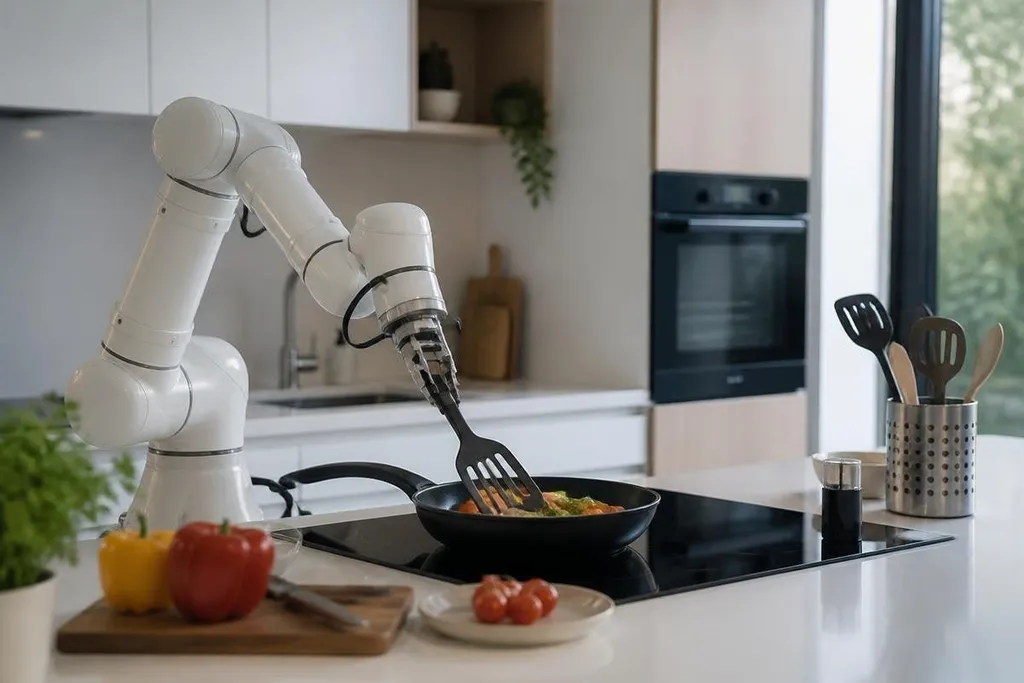
A robot that cooks at home has to handle heat, food, tools, spills, and changing ingredients in one small room. That is a harder task than moving a box across a marked factory floor, so the first useful systems will likely focus on a few repeatable jobs.
- Repeatable prep: cutting, weighing, and mixing suit fixed steps.
- Controlled heat: ovens and cookers are easier to manage than open pans.
- Human handoff: a person may still season, check texture, and serve.
The kitchen is a hard place for a robot
A kitchen changes from one meal to the next. A tomato may be soft, a pan may be hot, and a drawer may be left open. The robot has to see these changes and adjust its motion without dropping food or touching the wrong surface.
That calls for cameras, force sensors, and temperature sensors. A camera can help locate a bowl, while force feedback tells the arm how hard it is pressing. Temperature data can show if a pan or cooking surface is safe to approach.
The robot also needs a way to recover from mistakes. If a spoon slips into a bowl, the system must find it, pick it up, and continue from a known step.
A fixed recipe is not enough when the physical scene keeps changing.
What early cooking systems can handle
The first useful machines will have a better chance with work that has clear limits. One system could weigh ingredients, pour them into a vessel, stir for a set time, or move a prepared tray into an oven. Each job can use a known tool and a defined workspace.
Heat adds another layer. An oven has a set chamber and a known cooking program. An open frying pan is harder because oil moves, food changes shape, and the right cooking point may depend on sight, smell, sound, and texture.
That gap matters for anyone buying automation for a restaurant. A system that loads trays may fit a busy kitchen, while one that claims to cook any meal would need far more proof. The task list should come before the robot purchase.
Software will decide how much the arm can do
A cooking robot needs more than an arm with a gripper. Its software must split a recipe into steps, check the scene after each step, and stop when the next action could cause harm.
Teleoperation may help during early deployments. In that setup, a person guides the robot through a task while the system records movement and sensor data. Later runs may repeat parts of the task without direct control, though the amount of human input needs clear reporting.
A recipe change can expose limits that a smooth teleoperation demo hides. Cooking robotics reporting from Robot24.com can tie a claim to the robot, recipe, kitchen, and test result, so you can see how much a person still guides each run. The harder test comes when the robot has to judge the food after moving the tool.
The open issue is not only motion. Food has properties that are hard to measure. The machine may know where a piece of dough is, yet still struggle to judge if it has been mixed enough or cooked to the right texture.
What stays unproven
A video can show a robot making one dish. It does not show how the system handles a busy service, a blocked counter, a missing ingredient, or a clean-down cycle. Those cases decide if a machine can earn its floor space.
Costs will matter too. A robot needs power, floor space, software updates, cleaning, and repair. A restaurant owner would compare those costs with the price of paying a person for the same narrow task, not with the price of a research demo.
I’d wait for published task data before buying a cooking robot for a working kitchen. The useful proof would include run time, failed attempts, human intervention, cleaning time, and the range of dishes tested.
A buying checklist for the next few years
Use these questions before a trial or purchase:
- Name the task: Choose one job, such as tray loading or ingredient weighing.
- Check the handoff: Record where a person takes over and how often that happens.
- Measure recovery: Ask what the robot does after a dropped tool or blocked view.
- Price the full setup: Include sensors, software, training, cleaning, and repairs.
- Ask for test records: Look for the number of runs, failed runs, and dishes covered.
Cooking robots will make progress through narrow tasks that can be measured. The next useful question is not how many recipes a system names, but how many meals it can repeat safely when the kitchen stops behaving like a demo.